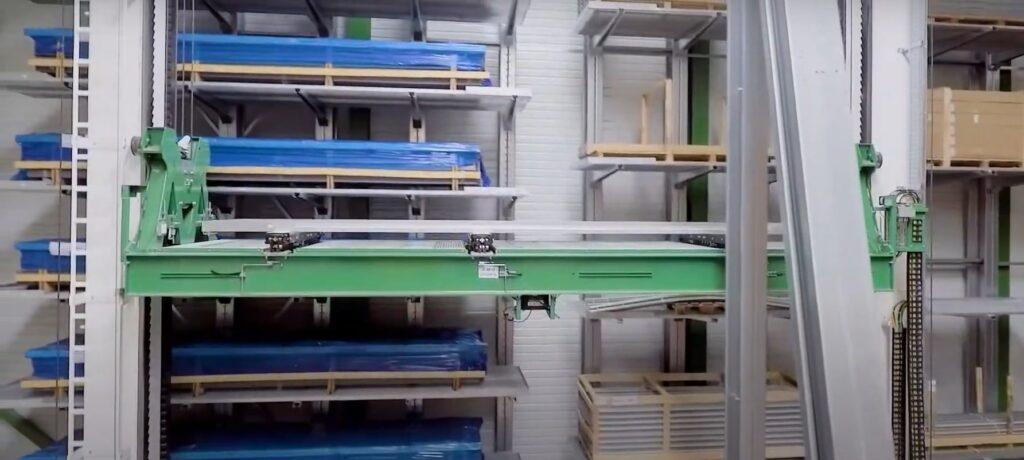
FIMEC SH designs and integrates stacker cranes for the automated storage of long, heavy or bulky products. The store connects production, order preparation and dispatch, using load carriers suited to the products.
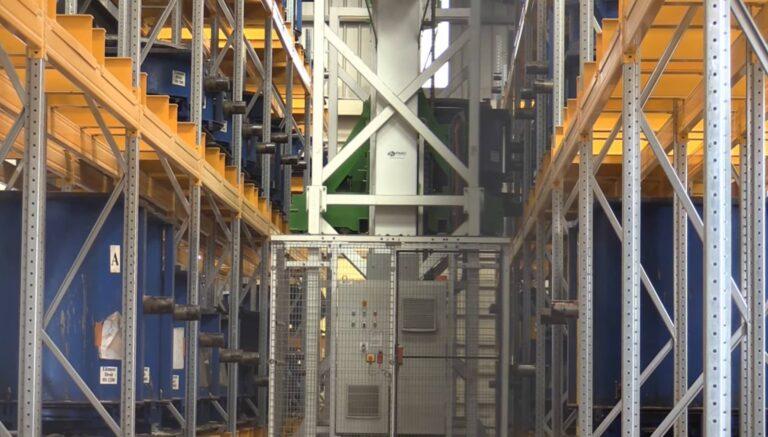
The concrete stacker crane stores filled moulds in the curing chamber and retrieves them after curing. Working with the carousel, it links mould preparation to demoulding and the discharge of finished products on pallets.
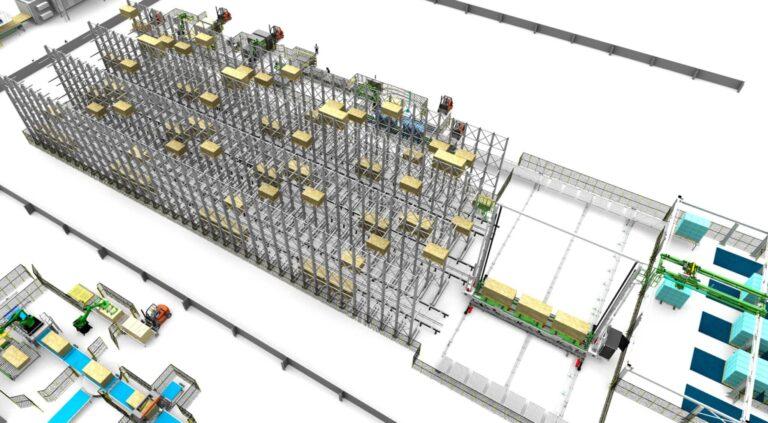
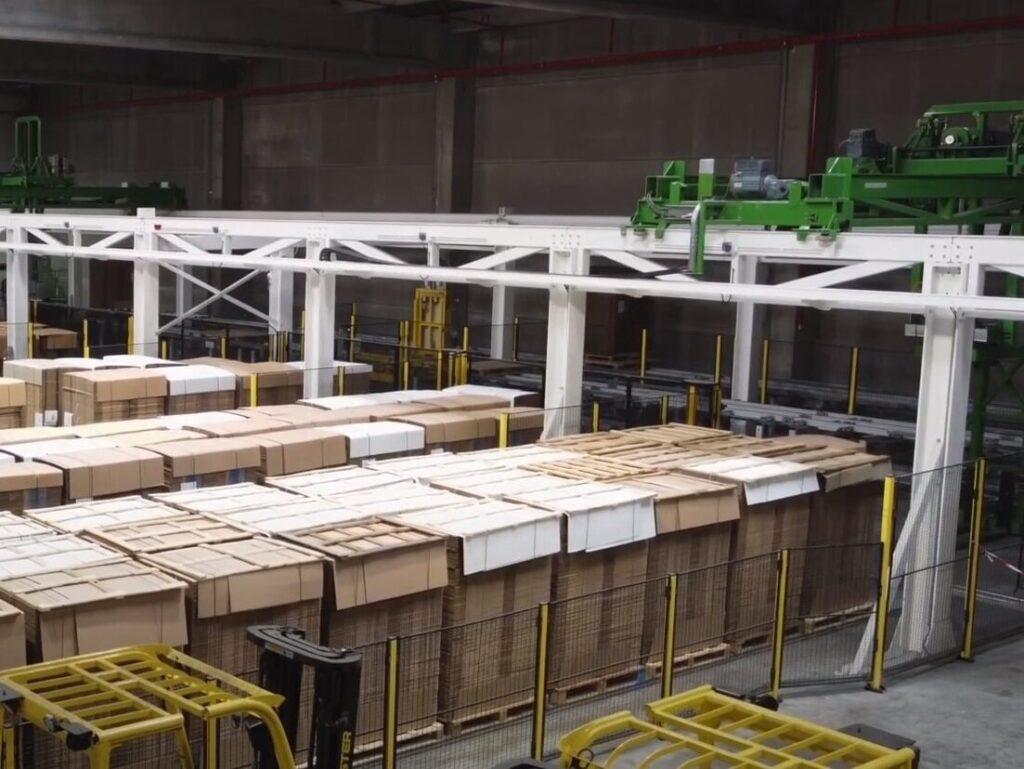
The insulation board stacker crane prepares pallets for dispatch. Combined with an automatic stacker, it assembles a truck load on a conveyor before the loads are collected.
The logistics stacker crane brings pallets, packages, rolls and intermediate products into a computer-managed store. It serves picking stations for order preparation and tracks stock movements.
Automated heavy-load storage is defined by product weight, geometry and support. The stacker crane receives the load at the store entrance, puts it away and retrieves it at the service station.
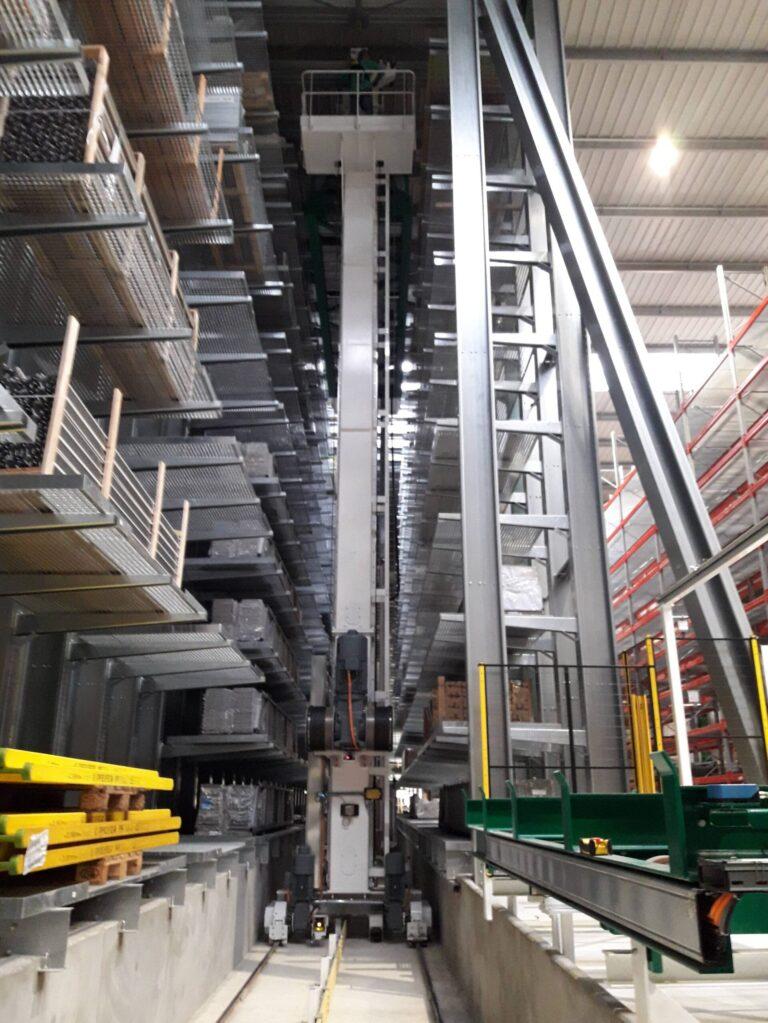
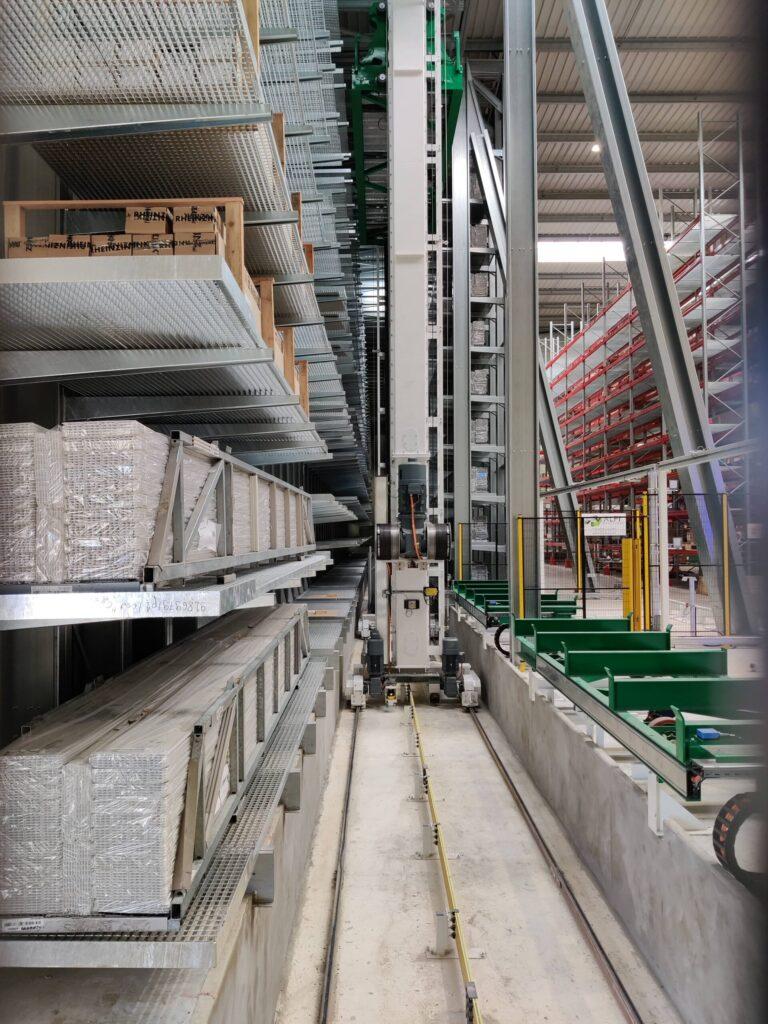
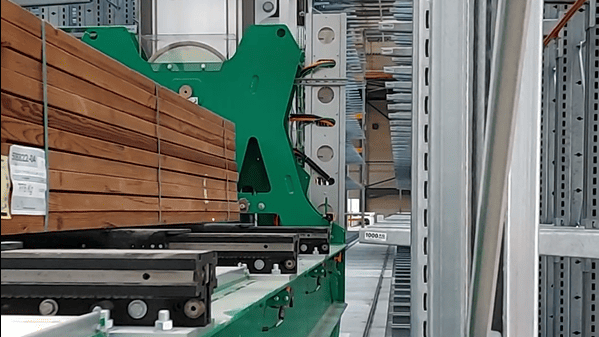
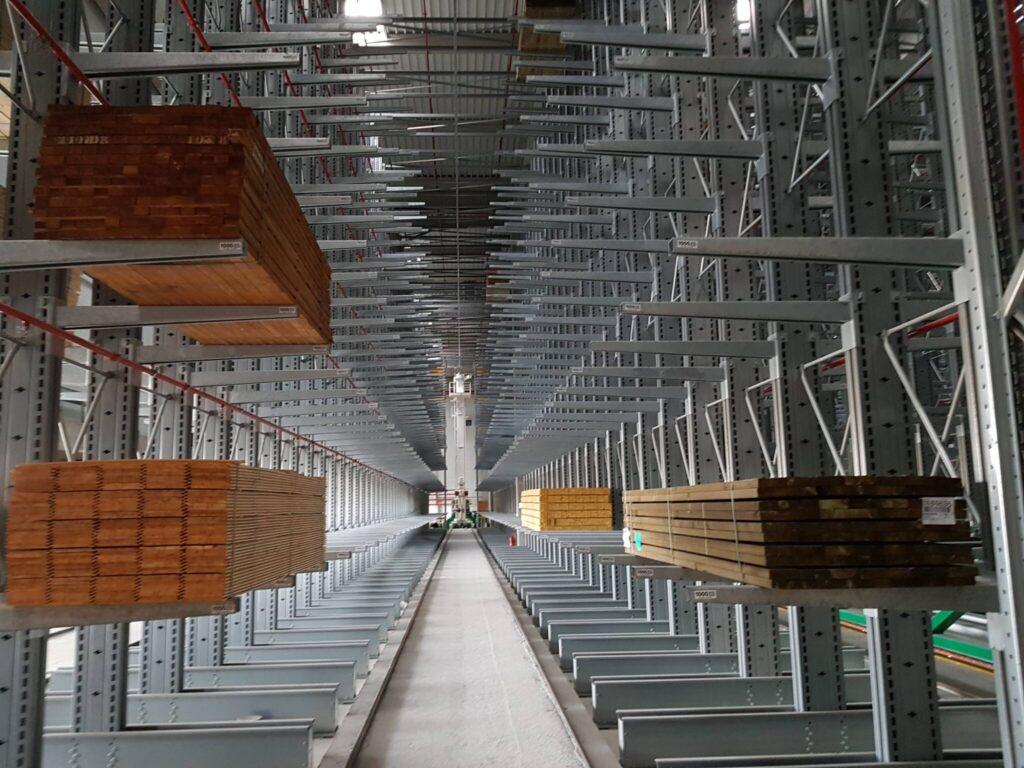
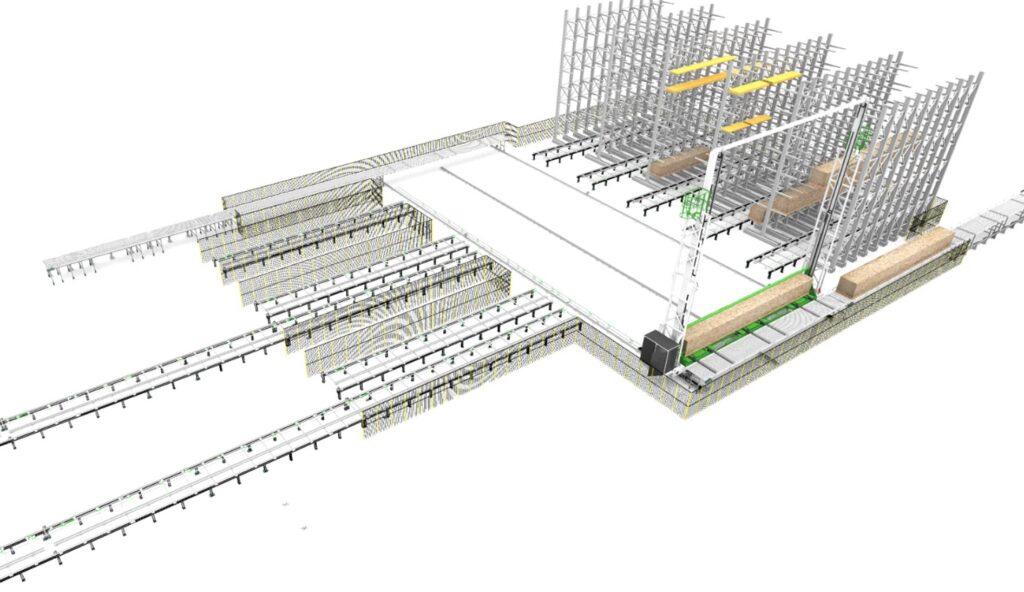
A long-product stacker crane serves a store for timber or other bulky materials. It connects storage positions to picking stations so orders can be assembled before dispatch.
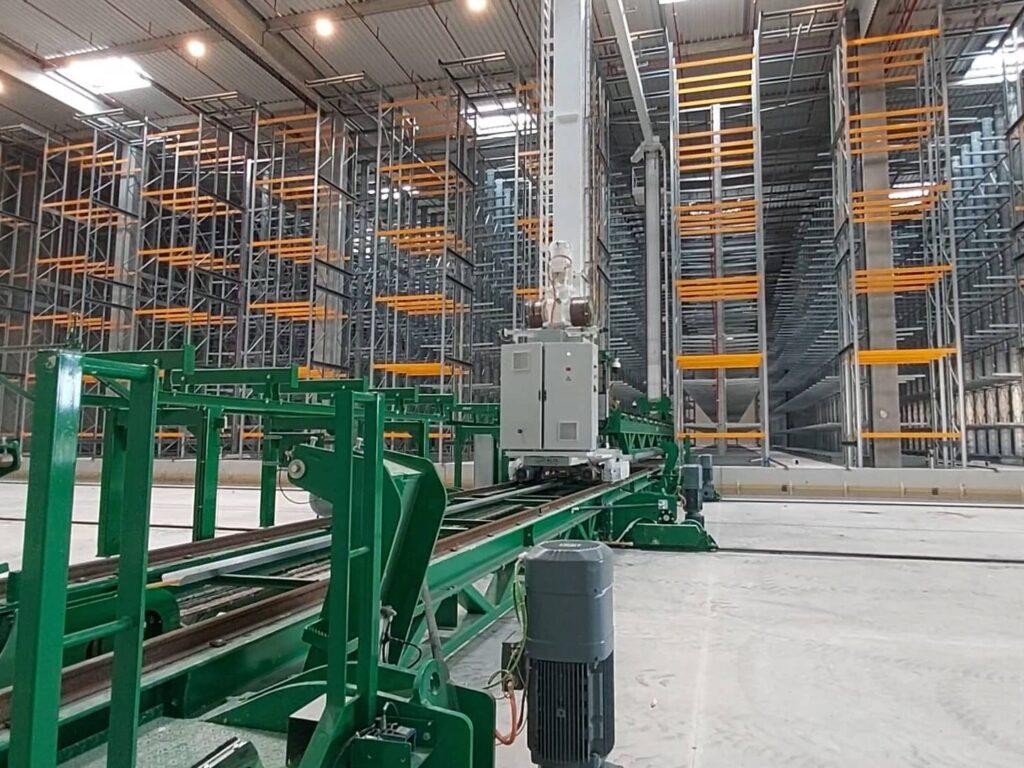
A stacker crane moves a load between a transfer station and a racking location. It travels along the aisle, lifts the load to the required level and transfers it into or out of the rack. An automated store combines this machine with load carriers, conveyors and movement control.
The handling cycle depends on the load unit: a pallet, a timber tray, a mould or a batch of panels. Its stability and pickup surfaces determine how the system is designed.
Infeed: the product and its carrier are identified at the transfer station.
Storage: the crane picks up the load and places it in the assigned location.
Retrieval: a production or order preparation request triggers delivery to the relevant station.
Industrial applications
Storage connected to factory operations
A store serves different purposes depending on its position in the process. It may supply raw materials to a machine, hold products between operations or organise retrieval before dispatch. Each flow has its own transfer and tracking requirements.
Timber and long products
Trays or carriers hold the references needed for an order. The preparation station must allow items to be picked and unused material to return to storage. Usable length is checked against the support points and the complete carrier envelope, including during transfers.
Insulation panels
Downstream of production, storage makes pallets available for dispatch. Preparation must account for loading order and the stability of each batch. Support points and transfers are defined around panel formats and susceptibility to damage.
Pallets, parcels and rolls
A store holding multiple references supplies picking stations and records movements. The stored unit must be defined clearly: a complete pallet, a parcel or a set of items on a tray. Picking and return-to-stock rules follow from that choice.
In precast concrete production, storage also forms part of the manufacturing cycle. The stacker crane places filled moulds in the curing chamber and retrieves them for demoulding. Residence time and planned batches determine the required number of locations. The concrete stacker crane page explains this application and its connection to the carousel.
The benefits
Four objectives to assess for your installation
01
Available space
Storage on several levels uses the volume of the building. Actual space savings must account for aisles, transfer stations and the access needed to operate the installation.
02
More regular flows
A buffer store can absorb differences between two operations. Its capacity and retrieval demand need to be checked against production peaks, picking activity and dispatch schedules.
03
Reference tracking
Load identification and location records support inventory checks and batch retrieval. Reliability also depends on the quality of the data recorded at infeed.
04
Product handling
Pickup arrangements defined for each carrier reduce improvised movements and intermediate handling. Operator stations, access and interventions still need to be assessed as part of the complete line.
Storage capacity and retrieval throughput are separate requirements. A large store can still be constrained by its preparation station or downstream conveyor. Flow analysis therefore needs to cover the complete cycle.
Technical choices
Load characteristics and flows shape the configuration
Load handling and carriers
Forks, trays, shuttles and onboard conveyors serve different transfer arrangements. Selection starts with the complete load and carrier, its support points, rigidity and position at the infeed station.
Pickup arrangements must suit the carrier at infeed, in storage and at outfeed.
Changes of product format belong in the specification.
Masts and movements
Single-mast and twin-mast designs are among the available stacker crane architectures. Selection depends on factors including height, weight and load geometry. A machine category alone does not specify the required configuration.
Available height is assessed alongside loads and building obstructions.
Movements must accommodate peak process demand.
Access to references
Single-deep racking provides direct access to each position. Double-deep layouts place one load behind another: storage allocation and retrieval order must then be assessed against the mix of stock held.
Single-deep storage gives direct access to each location from the aisle.
In double-deep storage, the front load affects access to the rear load. Allocation rules need to account for this.
Your project
Prepare the information needed for the study
FIMEC SH considers the store together with the handling equipment serving its infeed and outfeed stations. For an initial assessment, gather the following information and distinguish routine demand from peak activity:
Products: overall dimensions, weight including carriers, support points, fragility and range of formats.
Stock: references, quantities per reference, residence times and planned changes.
Movements: expected infeed and retrieval demand, simultaneous requests, operating hours and preparation sequence.
Building: layout, clear height, obstructions, transfer areas and maintenance access.
Control: load identification, stock management rules and exchanges with your software.
Operations: staffing, product access during a stoppage and installation constraints.
This information allows storage capacity to be assessed against the constraints of the line before the technical solution is specified.
A stacker crane is the machine that places loads in storage and retrieves them. AS/RS describes the wider automated storage and retrieval system, including racking, transfers and controls. The French spellings transstockeur and transtockeur refer to the same type of machine.
Start with the unit being handled. A tote, a pallet and a timber tray require different pickup arrangements. This comparison identifies the questions to assess for each family; it does not describe a FIMEC SH range of rated capacities.
Comparison point
Miniload for totes or cartons
Pallet stacker crane
Long products or special loads
Handled unit
Individually identified tote or carton.
Pallet and goods treated as one load unit.
Product, batch or mould together with its tray or carrier.
Pickup surfaces
Container base, rigidity and condition.
Fork openings, runners and pallet condition.
Support points defined around geometry, deflection and centre of gravity.
Workstation operation
Picking from the container and possible return of remaining stock.
Pallet infeed or outfeed; picking according to the workstation design.
Supply to a machine, order preparation or a process stage.
Information needed
Container dimensions and total weight; range of formats.
Actual dimensions, overhang and weight including the pallet.
Overall size with carrier, pickup points, fragility and transfer conditions.
Point to check
Compatibility of each container with the handling device.
Load stability during travel and transfer.
Product support throughout the handling sequence.
For insulation panels, long products or concrete moulds, the carrier description belongs in the initial brief. A maximum weight alone leaves the pickup and deposit conditions undefined.
Permitted weight, usable height and throughput are specified together. Weight includes the carrier, and dimensions describe the load as it arrives at the transfer station. Choose the case closest to your products to identify the information needed.
Long products
Overall length including the tray and any overhang.
Support positions, rigidity and potential deflection.
Quantity picked at the workstation and remaining stock returned to storage.
Pallets and panels
Actual height, width and length of the handled batch.
Weight including pallet, carrier condition and stack stability.
Preparation sequence and downstream loading requirements.
Moulds and heavy loads
Weight of the filled mould or load including its carrier.
Pickup points, centre of gravity and overall envelope.
Process residence time and required retrieval sequence.
For each case, provide a building plan with clear heights and obstructions. Figures from an example installation do not establish a guaranteed capacity for your project. The agreed performance requirements belong in the specification.
The store needs to identify loads, record locations and receive movement requests. How these functions are organised depends on your existing software and the role of storage in the factory. An ERP connection may supply production orders or customer orders; its scope needs to be agreed with production and IT teams.
Level
Role in the project
Exchanges to define
ERP
Business data and production or customer order requirements.
References, orders, expected quantities and completion information.
WMS or stock management
Stock, locations, batches and preparation requests.
Load identifier, location, quantity and retrieval priority.
Equipment controls
Transfer sequencing and execution of authorised movements.
Station availability, movement request, completion or fault.
An example sequence to validate
A retrieval request identifies a reference and quantity. Stock management selects the load to retrieve, then equipment controls arrange its transfer to the designated station. Confirmation must return to the system that tracks stock. The message detail and the point at which quantities are updated are agreed during interface design.
Exceptions deserve the same attention as routine cycles: an unreadable label, a missing load, an order cancelled after release or an occupied downstream station. For each case, decide who resolves it, where the information appears and how operation resumes. This list can then inform acceptance tests with your teams.
A consistent identifier should track the load across systems.
Priority changes and cancellations need explicit rules.
Loss of communication needs a defined system state and recovery procedure.
These exchanges may be distributed across several applications or grouped within a simpler architecture. The choice follows the functions required and the interfaces available at your site.
Yes, subject to a feasibility study. The apparent building volume does not determine the usable layout: columns, roof structures, services, doors, traffic routes and transfer stations all occupy space. The floor, supports and retained structures need assessment by the relevant specialists before their reuse can be confirmed.
A site survey should also establish how equipment will enter the workshop and how installation will fit around production. A connection to an existing conveyor may move the bottleneck to the next workstation. The study therefore covers flows around the store, maintenance access and commissioning stages.
Which documents do you already have?
Check the items available for an initial discussion. Your selection is a personal preparation aid.
Dimensioned layout showing equipment and traffic routes.
Clear heights, obstructions and services in the area.
Available information on the floor and structures to retain.
Load dimensions and weights, including carriers.
Expected infeed and retrieval demand during peak activity.
Installation constraints and possible production shutdowns.
An incomplete set of documents is enough to start a discussion. Missing information then becomes a point to survey or verify during the study; it should not be replaced with unconfirmed assumptions.
A quotation depends on the complete store and its interfaces. The machine is one part of the project, alongside racking, carriers, transfers, controls and installation. FIMEC SH does not publish a generic price range here: without load dimensions, storage capacity and movement requirements, it would not provide a useful basis for comparing proposals.
Cost item
What the proposal should define
Question to ask
Machine and load handling
Machine scope, pickup device and supplied carriers.
Are trays, special pallets or handling tools included?
Racking and building
New or retained structures, adaptations and associated work.
Who covers building assessments and alterations?
Transfers and workstations
Conveyors, infeed, outfeed, preparation and line connections.
Where does the supply scope start and end?
Controls and software
Controls, identification and interfaces to your systems.
Are interfaces, tests and other suppliers’ involvement covered?
Installation and start-up
Assembly, commissioning, tests and planned support.
What resources and production shutdowns must you arrange?
Operation
Maintenance, parts, assistance and intervention terms.
What remains to be budgeted after acceptance?
When approaching several suppliers, give each the same scenario: products and carriers, required stock capacity, peak infeed and retrieval demand, working hours, building constraints and equipment connections. Separate included services, options and work allocated to your company.
The economic assessment continues into operation. Maintenance requirements, spare parts availability, internal staffing and the consequences of a stoppage contribute to project cost. Any payback estimate should use your own production and operating data.
Access for inspection, intervention and component replacement.
Documentation, required parts and responsibilities for intervention.
Safe isolation conditions and restart procedures.
Production arrangements while the store is unavailable.
Define which references must remain accessible and what buffer stock is possible. These decisions influence the layout and flow design from the preliminary study.
Planning a production line or automated storage project?
This website currently uses only cookies necessary for its operation and to remember your choice. No advertising or audience-measurement cookies are active. You can review and change your preferences at any time.
Necessary
Always active
These technologies are necessary for the website to function and to remember your privacy choices. They cannot be disabled here.
Preferences
These technologies remember optional preferences you choose.
Statistics
These technologies measure how the website is used. They are enabled only with your consent.These technologies measure website usage anonymously.
Marketing
These technologies enable third-party content or advertising tracking. They are enabled only with your consent.